Thursday, September 6, 2012
Press briefing in 1 hour UPDATED
NASA's scheduled a press briefing on Curiosity's mission, set for 5pm GMT. I'll listen and comment on it later. You can watch it on NASA TV.

Tuesday, September 4, 2012
How's the weather at Gale?
Did you know they are giving daily weather bulletins on the weather at Curiosity's locality? The information comes from the REMS (Rover Environment Monitoring Station) instrument. Right now (i.e. sol 26) its sunny with temperatures at the highs of -1 degree Celsius and lows of -76 degrees Celsius.
Pressure is above the normal (636Pa according to wikipedia) at 743hPa (that's hectopascal which is equivalent to 100Pa; terrestrial air pressure is 1013.25hPa). That's an average for the whole day mind you.
They're also supposed to produce daily average relative humidity but so far they haven't. This may have something to do with the damage the instrument reportedly suffered (see this post). Relative humidity is simply put the amount of air that is saturated with water vapour. On Earth it is usually measured using 2 thermometers. One is hung out dry the other is hung out while being soaked with moisture (usually with muslin). This is a basic hygrometer. The moisture evaporates in to the air, cooling the 'wet bulb'. The 'dry bulb' will obviously register a higher temperature compared to the wet bulb. This difference will decrease in areas with a lot of moisture in the atmosphere. A meteorologist will check the difference against a table that gives him/her the relative humidity in percentage. Deserts will have a very low percentage (which is why when you sweat in Dubai in the breeze, you'll feel cool). In a tropical forest, the percentage is higher and that 'humidity' gives you a devastating heat wave as there is no where for your sweat to go to cool you. Yikes!
Winds continue to blow from the east at 2m/s. The winds can hit higher speeds, atleast enough to start global dust storm events.
These past few sols consisted of remote sensing to spot clouds above the rover. Clouds at the equatorials are usually of the wispy types called 'cirrus' clouds consisting of water ice crystals.
You shouldn't expect anything more than that. I don't know why exactly (comments anyone?) but most of the action in terms of clouds is at the polar regions (presumably because most of the water vapour migrates there).
You can see what I mean by what the Phoenix space craft (which landed in 2008 at Vastitas Borealis near the north pole) captured in one of its periodic cloud spotting activities shown below. Simply awesome!
For periodic weather reports visit this website here.
Pressure is above the normal (636Pa according to wikipedia) at 743hPa (that's hectopascal which is equivalent to 100Pa; terrestrial air pressure is 1013.25hPa). That's an average for the whole day mind you.
They're also supposed to produce daily average relative humidity but so far they haven't. This may have something to do with the damage the instrument reportedly suffered (see this post). Relative humidity is simply put the amount of air that is saturated with water vapour. On Earth it is usually measured using 2 thermometers. One is hung out dry the other is hung out while being soaked with moisture (usually with muslin). This is a basic hygrometer. The moisture evaporates in to the air, cooling the 'wet bulb'. The 'dry bulb' will obviously register a higher temperature compared to the wet bulb. This difference will decrease in areas with a lot of moisture in the atmosphere. A meteorologist will check the difference against a table that gives him/her the relative humidity in percentage. Deserts will have a very low percentage (which is why when you sweat in Dubai in the breeze, you'll feel cool). In a tropical forest, the percentage is higher and that 'humidity' gives you a devastating heat wave as there is no where for your sweat to go to cool you. Yikes!
Winds continue to blow from the east at 2m/s. The winds can hit higher speeds, atleast enough to start global dust storm events.
These past few sols consisted of remote sensing to spot clouds above the rover. Clouds at the equatorials are usually of the wispy types called 'cirrus' clouds consisting of water ice crystals.
 |
| Cirrus clouds on Earth (Commons) |
You shouldn't expect anything more than that. I don't know why exactly (comments anyone?) but most of the action in terms of clouds is at the polar regions (presumably because most of the water vapour migrates there).
You can see what I mean by what the Phoenix space craft (which landed in 2008 at Vastitas Borealis near the north pole) captured in one of its periodic cloud spotting activities shown below. Simply awesome!
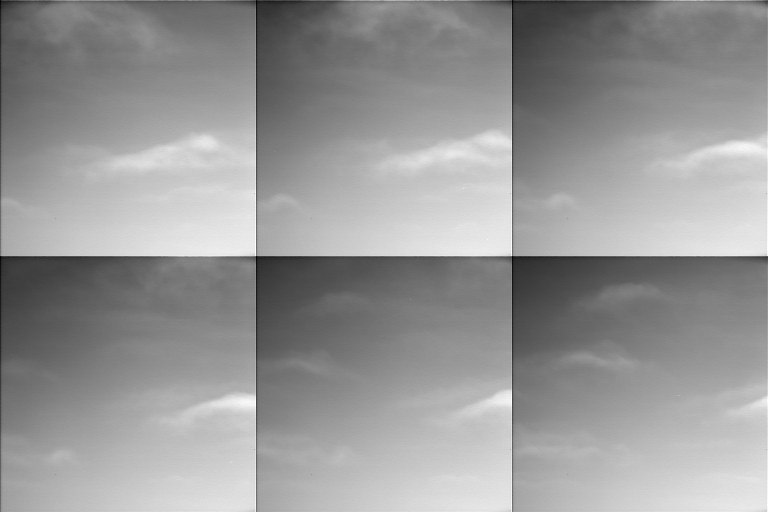 |
| Clouds by Phoenix (Commons) |
Saturday, September 1, 2012
Sol 24 drive
Curiosity has completed its fourth drive sequence since
landing on August 6. This drive took it 21m further east, bringing it to around
not less than 380m nearer to its destination, Glenegl.
I have managed to produce a panorama using the navigation
camera shots that the rover usually takes after every major drive (in order to
update its position). Its not my best pan job but it serves the purpose of illustration. A good chap from unmannedspaceflight.com has started to
produce kml files showing the position of the rover which we can view on Google
Earth. So we can compare the two views.
 |
| 360 degree view from sol 24. Note the tracks on the left side. (NASA/JPL/Panorama by me) |
 |
| View of trek progress from Google Earth. (Google. Map by Tesheiner from UMSF) |
The total mileage so far should be not less than 43m (that’s
only an estimate as I don’t remember how many metres they drove in the first
drives, only how far they went from Bradbury Landing).
In other news, NASA has released a brand new HiRISE image
from MRO (the telescopic camera in orbit that can see desk-sized objects on the
surface) taken of the rover and its scattered landing hardware and it’s better
than previous images because the angle of roll (the angle between the camera’s
line of sight and the line perpendicular to the surface which would be ‘nadir’)
was only 9 degrees which would improve the imaging quality as your subject isn’t
placed so far away. It also means less of the atmosphere in the way which would
otherwise produce a worse shot with the increased amount of dust in the way.
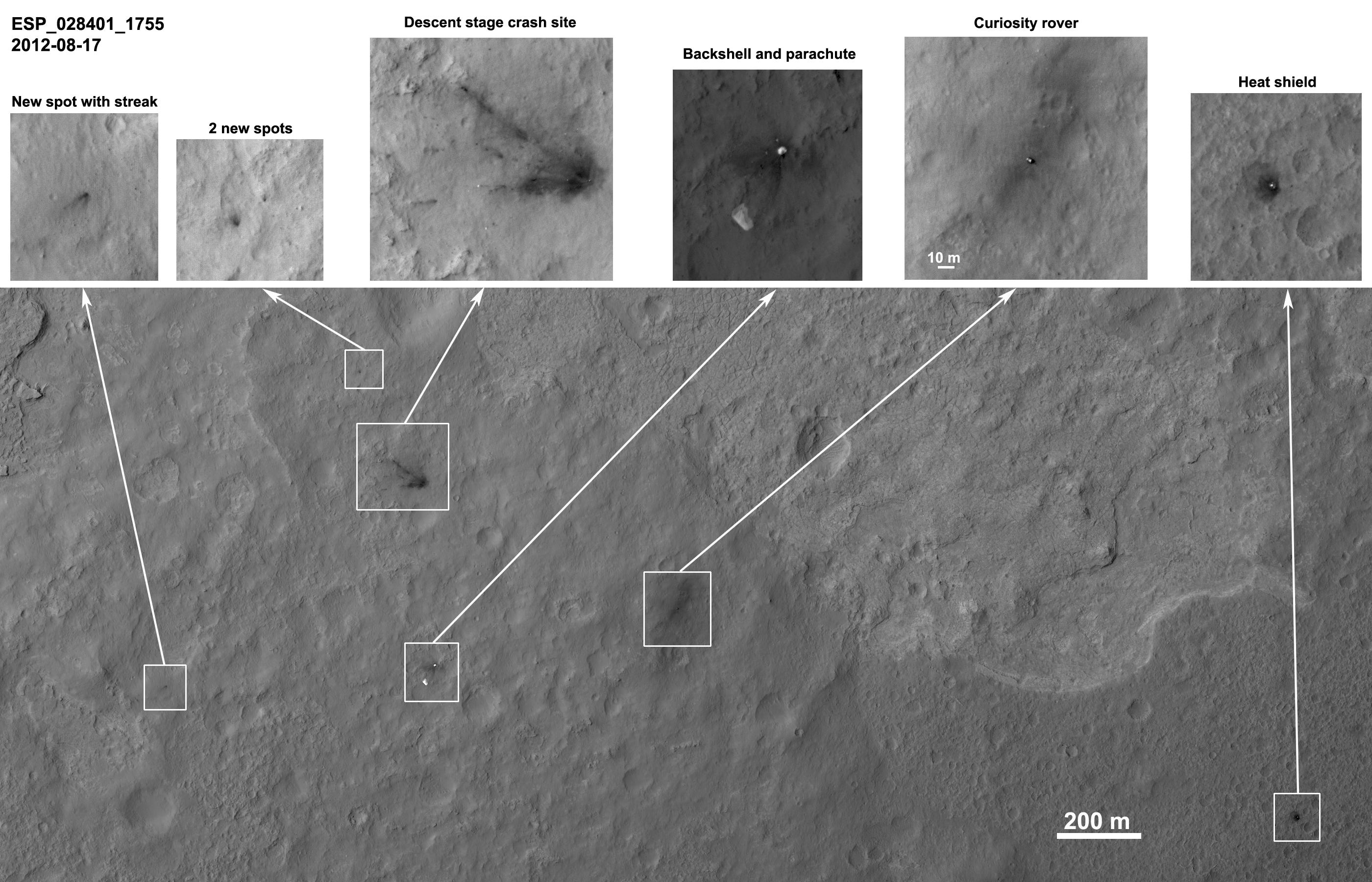 |
| View from HiRISE (NASA/JPL/UA) |
You can see plenty of debris around the rover in exquisite
detail (you can even see, in the ballooned insets, the rover’s wheels, shadow
of its mast and the RTG [radioisotope thermal generator] attached to the back
of the rover).
It’s now approaching evening of sol 25 at the landing site.
Stay tuned.