As you know, the rover Curiosity has exited the period of solar conjunction which was characterised by low science returns. As of now the rover has finished booting into its new software which includes better auto navigational capabilities which allow the rover to navigate most routes pretty much on its own without intervention from Earth (see the video update at the end of this blog post).
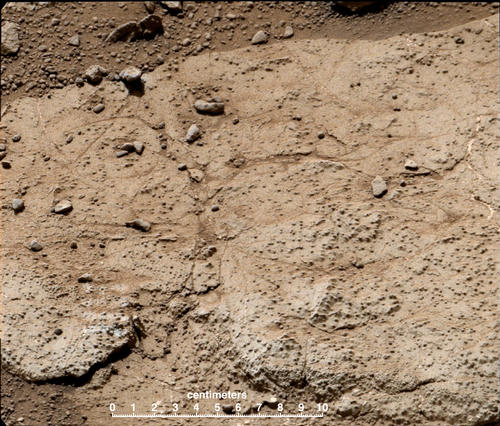
The new target for drilling has been chosen. Dubbed 'Cumberland', the target features numerous features typical of the wet ancient environment that has been the subject of much of the mission's time this past few months. Among the features you may notice is little round concretions that have resisted erosion and stick out of the rock like weird raisins. These are actually concretions; minerals that may have precipitated out of liquid water in the remote Martian past. You can also see thin white cracks. These are gypsum veins which also imply a watery history at least at Curiosity's location.
 |
A white balanced image taken on sol 192 showing
Cumberland. The image was taken with the 100mm
right mastcam eye. Note the 10cm scale at the bottom
of the image. (NASA/JPL/MSSS) |
The new target lies west of the rover's current location. A small 'bump' is all it will take to reach as it is fairly close by.
 |
Map showing the location of John Klein and Cumberland. North is up
(NASA/JPL/Univ. of Arizona) |
At Cumberland, it'll be all about drilling! But some of you may note; why is the rover targeting a rock that, by all accounts, looks exactly the same as the previous one i.e. John Klein. The
recent news report on the mission home site explains:
This second drilling is intended to confirm results from the first drilling, which indicated the chemistry of the first powdered sample from John Klein was much less oxidizing than that of a soil sample the rover scooped up before it began drilling.
The first drill sample may have had some contaminants from all the previous scoopings of Martian soil. Therefore it only seems proper to take yet another sample of the same rocktype from a different locality and compare the findings with the hope that whatever contaminants there are are now likely from a similar rocktype. The results will be more refined and trustworthy.